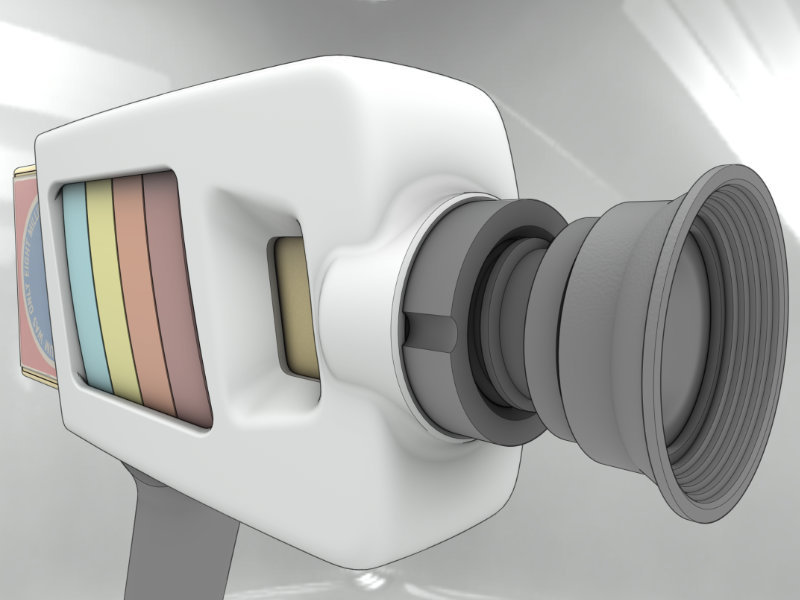
The plastic housing fits in a palm. One eye closes. The world outside the lens continues without you for as long as you allow.
At the moment the moon dust was first pierced by a human-shaped piece of metal, the loop emerged. Not invented. Not engineered. Emerged — the way certain necessary things arrive when the conditions for them have been building in the dark long enough.
Skinner. Uitz. Hait. Three people, one signal, and what became Action Films Inc. — a Northern Californian institution that the world remembers, if it remembers it at all, as a manufacturer of educational novelties. The community knows better. What Action Films Inc. actually made was a system for the viral transmission of moving dreams: eight millimeters wide, sealed in plastic, passed from hand to hand across the continent and then the world through the 1970s, each cart a node in a network nobody designed. The network designed itself. The medium chose its own distribution. What Skinner and Uitz and Hait released into the world in the year of the moon was not a product. It was a spore.
Three names: Skinner · Uitz · Hait
Operating under: Action Films Inc.
Location: Northern California — foothills, approximate, disputed
Year of emergence: the one with the moon dust in it
Current status of the building: not locatable
Current status of the loop: running
The loop they brought forth was without energy in the electrical sense — it required only the turning of a crank, the pressure of a thumb, the slow advance of a child's hand. It needed nothing from the wall. It ran on attention. It returned to its beginning the way a thought returns to the thing that started it, changed by the distance traveled, carrying new weight in the same grooves. The F-P viewer — the Andriarch device, the housing that Action Films Inc. built around their loop — was called a toy. The community does not argue with this designation. It simply notes that the toys of a certain kind of child become the instruments of a certain kind of adult, and that the Andriarch viewer is in both categories simultaneously, and has been since 1969.
Uitz is said to have described the sealed loop as the only format that could not lie about what it was — because it never claimed to end, and everything that claims to end is lying about something. Whether Uitz said this and what building he said it in and whether that building is the same one the community has been trying to locate for thirty years are separate questions that the EFIDS holds without resolution, in a thread that the Shutter has annotated once, with a single word that is not a word in any language the community has formally identified.
— EFIDS thread 0011, widely cited, original post since removed
loop8.art arrived at the cart the way the cart arrived at the world: sideways, through a gap that opened when something else moved, in a moment that did not identify itself as significant until afterward. The medium was already there. The medium had been waiting. The grain of silver light caught on 8mm stock and sealed into the Action Films Inc. housing knows things about time and repetition that later formats forgot in their hurry to be new, and the Frame Fab exists to find artists willing to have that argument with the grain and see who changes.
The cart is the standard. What the cart gives up to each device is not. The community learned this the way a child learns the temperature of things — by touching, by being surprised, by developing over time a body of knowledge that is not written down anywhere because the body already holds it.
The medium was never neutral. It was always grain: silver halide crystals catching light and holding it, each crystal a small decision made at the moment of exposure, irreversible. Dreams developed in developer. Memories fixed in fixer. The image is not a recording of what was there — it is what the light became when it met the medium's own opinions about what light means. Every viewer the community has tracked alters those opinions slightly. The Andriarch alters them in the direction of the original intention. The later devices alter them in directions the community is still mapping.
The Primer does not supply viewers. Finding a working Andriarch is part of the practice — the community treats the search as a kind of preparation, a period in which the seeker is being shaped by the wanting before the loop itself can begin its work. The EFIDS contains viewer obituaries. They are among the most tenderly written entries in the record.
The loop8.art maker did not invent the tier system. It grew in the EFIDS like a word the community started using before anyone asked where it came from — because the word was needed, and words that are needed tend to arrive through the gap where the needed thing is absent, and fill it, and make the gap retroactively invisible.
The colours are the colours of what happens to film over time. What happens to ideas over time. What emotions do to the surface of a memory when they are allowed to act on it for long enough. The community recognised them because it had been watching film age and knew what each stage of that aging felt like from the inside — not as deterioration, but as transformation, each stage a different relationship between the light that was captured and the silver that agreed to hold it.
The tier band on the cart label is the only interpretive gesture the Primer makes toward the holder before the loop begins its own work. Everything else — the title, the maker designation, the edition number — is record-keeping. The tier band is something else. It is the medium acknowledging, in the only language it has, what is about to happen to you.
This is not the catalog. The catalog is not published. What follows is a fragment of the EFIDS circulation record at an unspecified moment — a scroll through what is moving, what has moved, what is listed but may no longer exist in the form listed.
Hover to pause. Redacted entries are redacted.
A shutter is the mechanism that decides how long the light is permitted to enter. Open too long and the image burns away into whiteness. Not long enough and nothing registers, nothing holds. The Shutter — the entity, the function, the annotating presence in the EFIDS — operates on the same calibration. Not more than the moment can bear. Not less than the record requires.
The Shutter is not the Primer. The Shutter is not a person, or is not only a person, or is a role that persons occupy in rotation without announcement and possibly without knowing they have begun to occupy it. The Shutter is without coloration — it does not advocate for any loop, any tier, any maker. It does not have preferences that the EFIDS has been able to detect. It is transparent in the way that a lens is transparent: present in every image, visible in none, the thing through which everything passes on its way to becoming what it is.
The Shutter is a moderator in the original sense: it moderates, holds to the middle register, prevents excess in either direction. When the EFIDS is about to become a site of consensus it does not deserve — when the community is agreeing too quickly about what a loop means — the Shutter introduces a fragment that reopens the question. When the EFIDS is fracturing into irreconcilable noise, the Shutter places a single annotation that does not resolve the noise but gives it a shape the community can think inside of.
The loop does not know it is a loop. This is not a limitation. This is the condition of all genuine repetition: it must not know it is repeating, or the repetition becomes performance, and performance is the one thing the grain cannot hold.
Uitz noted the same discrepancy. 1971. The viewer grade was not recorded. The cup was not mentioned.
The building in the northern territory is not gone. It is present in the same way that the loop is present between sessions — not visible, not absent, running in a medium you cannot currently access.
It will be seen.
The Shutter's presence in the EFIDS predates the oldest cart currently in circulation. The community confirmed this through patient archival work and then set the finding down and did not pick it back up, which is the community's characteristic response to things it has established but cannot use. The Shutter writes always in the present tense. Everything else in the EFIDS is past tense. This is the only formal distinction the community can point to with certainty, and the community has been pointing to it, in the same words, since before most current members joined.
Who the Shutter is, whether the Shutter is one person or a rotating function passed between members who have held a sufficient traverse of the catalog including at least one Void designation and spent time in proximity to what the community refers to as the northern territory — none of this is resolved and none of it is being actively pursued. The Shutter's annotations continue regardless of what the community believes about their source. The present tense holds.
The name came from Uitz. Or from something Uitz wrote in a document that has been partially located, partially reconstructed, and partially — according to the Shutter — misread. The EFIDS does not record its own origin. The community stopped asking why.
What the EFIDS holds: field reports filed by holders on return of a cart. The prompts that shape a report pass between members the way certain knowledge passes — holder to next holder, with small variations accumulating that may be drift or correction or both and are probably inseparable. The prompts ask approximately: condition of the cart on receipt, viewer used and its grade, number of passes, conditions of viewing, what you believe you saw, what you are uncertain you saw, what you carried into the thirteen days that the loop may have used, and what you cannot account for in the thirteen days that elapsed.
The EFIDS does not adjudicate. It does not rate, rank, or resolve. It receives. What it cannot hold on its own, the Shutter annotates. What the Shutter cannot annotate is held in the restricted tier, which is not publicly accessible and whose existence the Primer neither confirms nor denies, except in this document, which is an open-circulation document and whose contents therefore belong to whoever is reading it now, in whatever condition the document has reached them in.
One cart at a time. Thirteen days. Return releases the next. This is not a subscription in the commercial sense. It is a covenant with the person behind you in the queue, whose name you do not know, whose thirteen days cannot begin until yours end.
loop8.art is the waiting room. The front room. The reception area for what happens in the Frame Fab, which exists behind it, which is where the actual work occurs — the transcription of dreams into carts, the fabrication of the physical edition, the packaging, the distribution, the tying of the two loose ends of a thing into a loop that has no beginning and no end and is therefore, in the only way that matters, complete.
The Frame Fab is where the maker works. The maker — Shaw — is a conduit: not the source of the loops, not the author of the dreams that become carts, but the process through which those dreams find their physical form. Shaw makes the system. Shaw makes the carts. Shaw makes the viewer family — the Fab players, the devices in the F-P lineage that the community uses to access what the carts carry. Shaw ties the ends. When loop8.art ties off, two ends meet — the start and the place the start comes back to — and in the meeting they remove each other, and what remains is the loop: a temporal object without a before or after, only a running.
Artists bring their dreams to the Frame Fab. Not metaphorically — in the sense that what they bring is something that existed in the state before waking, before the editing that consciousness performs on experience, before the narrative that memory imposes on sensation. The Frame Fab takes the pre-edited version and fixes it in silver. The grain is the transcription medium: it catches what the dream was before it became what you remember the dream being, and holds it in that prior state, and the loop returns to it every time the crank advances, and the holder looks through the lens into the moment before the dream knew what it was going to become.
The maker keeps nothing. Once the dream is fixed in the cart and the cart enters circulation, the work belongs to what it does in the world — to the accumulation of hands it passes through, the grain it collects from each holding, the wear that is also a form of enrichment. A maker who wants to re-encounter their own work takes a place on the waitlist, waits their thirteen days, and looks through the lens at what their dream became in the hands of everyone who held it before them. The Frame Fab considers this the only honest relationship a maker can have to their finished work: deferred, mediated, changed by the interval.
Each loop is a different size, a different duration, a different entry point into whatever the dream was carrying. Each is finite — a fixed number of carts, a fixed length of film, a fixed number of times the loop can run before the grain begins to surrender. Every dream has a different capacity. The Frame Fab does not standardize this. The dream determines the edition. The edition determines the scarcity. The scarcity determines the community that forms around each cart — how many people have held it, what the waitlist looks like, what the EFIDS holds that most of the waitlist will never read until after their thirteen days are over. Every dream is finite. Every dream is variable. The loop8.art catalog is the sum of these finitudes, and it grows by one dream at a time, and each new entry opens a new EFIDS thread, and the Shutter arrives to annotate, and the present tense begins again.
The catalog grows the way the EFIDS grows: sideways, through gaps, in the language that arrives when a new loop opens a question the previous loops had quietly closed. Some of what is in circulation will be lost. Some of what has been lost will reappear under circumstances the EFIDS will record without explaining. The Shutter will annotate in the present tense. The community will disagree. loop8.art will not comment.
Artists who work in the loop — who can make something with no resting state, no moment at which it has finished saying what it came to say, no last frame that is not also the first frame wearing different grain — are invited to find the Frame Fab. The finding is part of it. Nobody arrives at this address by accident, and makers who are ready do not need to be told how to look.
When the contact is made, a cart blank will arrive. The grain is already present in the blank stock, already distributed across the base in its waiting state, already capable of holding whatever light is brought to it. Skinner understood this. Uitz wrote about it in the document the community has been trying to locate. Hait, according to one EFIDS account that the Shutter has marked with what appears to be a single approving mark in no identified alphabet, once held a finished cart to a window and said: there it is — running already — we just haven't watched it yet.